
Premium Tarps & Tarpaulin Manufacturer

+86 15601786499 (steven)

info@der-factory.com

中

Update time:2026/11/2 23:53:25 Views:0

Clear flexible materials / Outdoor selection guide

Clear PVC for Outdoor Use: UV, Thickness & Weathering Guide

Can transparent PVC stay clear outside? Start with the formulation and exposure, then specify the correct thickness, optical quality, fixing design and acceptance tests for your finished panel.

For patio-enclosure manufacturers, tent and marine fabricators, industrial converters and bulk material buyers.

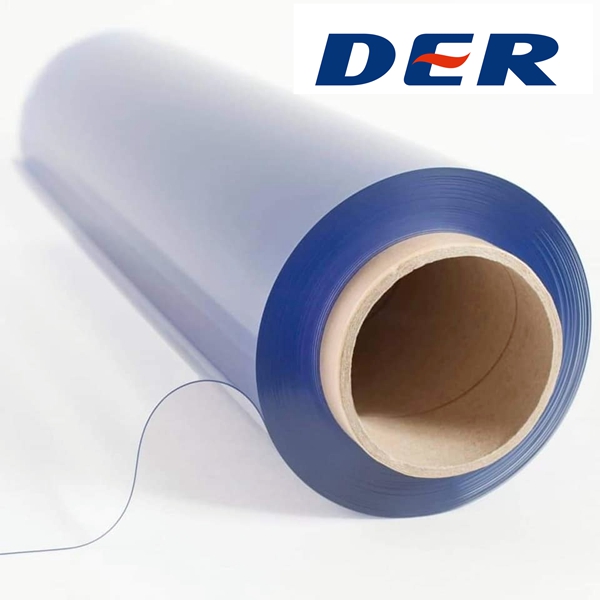
Roll of flexible transparent PVC film with clear glossy surface and blue-tinted roll edge
DER factory transparent PVC roll stock. Roll-edge tint can differ from the appearance of a single sheet.
UV grade firstIndoor clarity does not establish outdoor weatherability.
20 / 30 / 40 milUseful comparison gauges—not wind-speed ratings.
Test the assemblySeams, fasteners and supports control installed performance.
Direct answer

Can clear PVC be used outdoors?

Yes—flexible clear polyvinyl chloride (PVC) can be used outdoors when the selected grade is formulated and evaluated for the actual exposure. Clear PVC sheet forms a continuous waterproof barrier and provides visibility for patio enclosures, tent windows, removable curtains and soft protective panels. However, ordinary indoor-grade clear vinyl may yellow, become hazy, stiffen or change dimensions after prolonged sun and temperature exposure. For an outdoor application, specify UV/weathering requirements, expected temperature, nominal thickness, optical acceptance criteria and the complete edge-and-fastener arrangement. The finished assembly—not film thickness alone—determines rain ingress and wind-related behavior.

01 / MATERIAL

Flexible, not rigid

This guide concerns transparent, non-rigid PVC rolls and panels. Rigid PVC, acrylic and polycarbonate glazing are different constructions and should be selected separately for structural needs.

See DER factory’s super clear PVC film range for the material family.
02 / CLIMATE

UV is only one stress

Sunlight, warm surfaces, low-temperature handling, airborne grit, rainwater and repeated folding can all affect clarity and serviceability. Put the exposure conditions into the purchase specification.

03 / INSTALLATION

A sheet is not a wall system

Clear PVC should not be represented as impact-rated safety glazing or a wind-rated wall without engineered system evidence. The support, reinforcement, drainage and hardware are separate design items.

Thickness selection

What thickness is suitable for outdoor clear PVC?

There is no single outdoor thickness that fits every project. Heavier sheets resist some forms of handling damage but add weight, need larger bend radii and place more demand on fixings. Start from the panel design and trial the intended gauge.

Nominal sheet thicknessApprox. milWhere to evaluate itDesign checks before ordering
0.30 mm11.8 milLight-duty, small or sheltered transparent inserts that are not heavily tensioned.Creasing, tearing at the edge, panel size and storage handling.
0.50 mm19.7 mil (near 20 mil)Roll-up soft windows and lighter patio-panel trials.Cold flex, handling frequency, border reinforcement and support spacing.
0.75–0.76 mm29.5–29.9 mil (near 30 mil)Patio and tent enclosure panels comparing drape with added substance.Flatness, roll diameter, welding procedure and overall panel mass.
1.00–1.02 mm39.4–40.2 mil (near 40 mil)Heavier transparent curtains and less frequently operated panels.Stiffness in cold weather, hardware capacity, bend radius and seam design.

Conversion: 1 mil = 0.001 inch = 0.0254 mm. The table is a buyer comparison—not a claim that every grade and width is in stock. The existing DER factory sheet product information has described a 0.3–4 mm family and up to 2 m width, but availability must be confirmed for the chosen formulation and thickness.

Why thickness does not prove outdoor life

A thick general-purpose indoor film can age less favorably than a thinner outdoor-stabilized grade. Request the grade identity and weathering method before comparing quotes. A 30 mil panel contains approximately 50% more PVC material per square meter than a 20 mil panel of comparable density, before fabric borders or accessories; overall installed weight is higher as well.

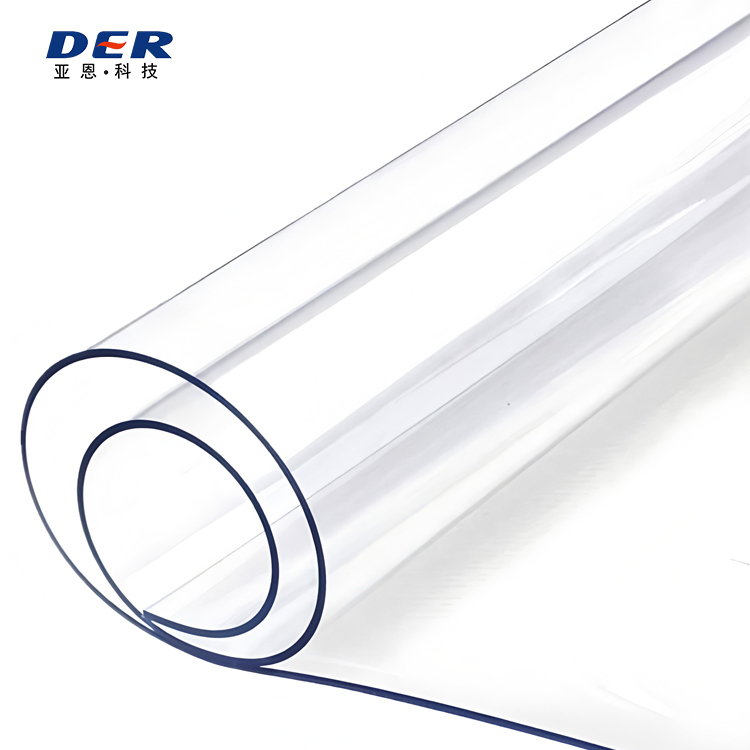
Clear flexible PVC sheet showing transparent surface and naturally curling edge
Surface and edge appearance. Approve transparency and tint using a single layer at the actual ordered thickness.
Practical measurement advice

Specify thickness with tolerance, not just “gauge”

Supplier “gauge” names can be ambiguous. A purchase order should name the gauge in millimeters or mils, define its permitted variation and note where it is measured. Request the usable roll width, not only the nominal width, for panel cutting.

If the buyer needs a broad factory supply reference for clear rolls rather than outdoor application guidance, use the clear PVC film sourcing page.

Weathering performance

UV resistance, yellowing and haze: what should you verify?

An outdoor-grade film needs defined performance after exposure, not an unqualified “UV-proof” label. Transparent PVC can experience color change, surface haze, stiffness or dimensional changes under sunlight and heat. UV stabilizers can help, but formulation and conditions determine the outcome.

LIGHT & OPTICS

Clarity and yellowing are different measures

A sample may still transmit light while showing yellow tint, increased haze or optical distortion. Define a retained unaged reference, a visual comparison condition and—when needed—instrument measurements for luminous transmittance and haze.

ASTM D1003 is a recognized test method for luminous transmittance and haze of transparent plastics. It does not itself establish a complete outdoor service-life rating.

AGING CONDITIONS

Ask what an “UV hours” claim means

Request the apparatus, lamp or light source, cycle, temperature, moisture conditions, specimen gauge and measured outcomes. ASTM G154 addresses fluorescent UV exposure conditions; G155 is a separate xenon-arc practice. Test hours cannot safely be translated into real-world years without an appropriate validated relationship.

For transparent-material alternatives when abrasion or repeated flexing dominates, compare the properties of TPU film at the actual grade level.

STEP 01Describe exposure

Location, sun direction, season, temperature, cleaning.

STEP 02Select grade

UV package, softness, gauge, tint and surface finish.

STEP 03Approve evidence

Samples, aging method, haze/color and dimensions.

STEP 04Validate the panel

Welds, borders, hardware, drainage and repeated use.

High sun and heat

Prioritize weathering evidence, dimensional stability, edge movement and maintenance. Do not assume a greenhouse film specification equals a clear-window optical grade.

Cold weather and roll-ups

Test the selected grade at realistic handling temperatures. Repeated folding of cold stiff film can create stress marks and increase failure risk at attachment points.

Marine or coastal environments

Consider salt residue, grit, UV exposure, corrosion of fasteners and cleaning needs. Salt-air suitability and UV resistance are different questions; request relevant evidence for the full assembly.

Match material to environment

Where does outdoor clear PVC work—and what changes by application?

Buyers often ask for “waterproof transparent plastic” without describing how it will be moved or fixed. These factors change the material requirement more than the product label.

Outdoor applicationMain selection priorityPotential failure point to reviewFabrication / procurement note
Patio and porch curtainsVisibility, softness, UV/weathering stability.Stiff roll-up, edge pull-out, bottom ponding.Trial complete hanging width with hem, zipper or track.
Event tent windowOptical appearance, weld compatibility and folding behavior.Stress at clear-to-opaque fabric transition.Pair the window trial with the actual tent border fabric.
Industrial transparent curtainRepeated movement, cleaning and safe visibility.Grommet tearing or abrasion from adjacent hardware.Use separate reinforcement geometry where loads are transferred.
Marine soft enclosureOptics, UV evidence, salt residue and hardware corrosion.Surface scratches, yellowing and difficult cleaning.Approve care plan, fittings and any marine exposure tests.
Temporary weather coverWater barrier, panel weight and attachment design.Rain entry at seams, abrasion and flutter.Consider outdoor clear PVC sheet products for cut-panel and sourcing options.
Need a clear window and a stronger edge?

A transparent viewing film is not always the right material for a tensioned perimeter. A compatible opaque or reinforced border may better carry grommet, zipper and mounting loads.

Review PVC Coated Fabric
Roll core and layers of flexible transparent PVC sheet prepared as industrial roll stock
Roll packaging reference. Core, winding tension, protection film and storage affect downstream appearance and handling.
Close-up of a transparent flexible PVC sheet with smooth glossy surface
Optical-quality reference. Confirm haze, scratches, tint and visible defects at final gauge before series production.
Panel design & maintenance

Prevent problems at edges, seams, folds and cleaning points

An intact PVC sheet blocks liquid water. A weather-resistant installation depends on the assembly details and ongoing use. Treat each connection as a separate design and inspection item.

ATTACHMENTS

Reinforce load-bearing borders

Place eyelets, D-rings, zippers, track attachments and tensioning points into a designed reinforced perimeter where feasible. Do not assume an unsupported clear film has a rated pull-out strength. Align hole spacing, edge distance and spacing of fixings with the system design.

For fully fabricated products, custom tarp construction explains additional finishing considerations.

JOINTS & RAIN

Seal joints and control drainage

Agree whether sheets will be heat or high-frequency welded, sewn to borders or fitted mechanically. Confirm the joint method with the actual selected materials and weld trial. Provide shingled overlaps and drainage paths where practical; a waterproof film cannot prevent water entry through an open top or poorly detailed seam.

CARE

Clean without damaging the surface

Remove grit with water before gentle wiping; use only the cleaner approved for the selected PVC formulation. Test new cleaners on an offcut. Avoid unapproved solvents, abrasives and aggressive pressure washing. Rinse and dry before folding or storage.

STORAGE

Avoid hot, tight folds

Where practical, roll panels around an appropriate core, protect polished surfaces from abrasion and avoid trapping water or dirt between layers. Follow the grade-specific storage temperature instructions and inspect long-stored rolls before fabrication.

Common misunderstanding: “waterproof,” “UV-resistant,” “flame-retardant” and “safe for use as glazing” are four different types of claims. Each must be supported separately when required by the project or destination market.

Approval before bulk purchase

Outdoor clear PVC testing and sample acceptance checklist

The most defensible RFQ states what the panel must still look like and do after the agreed exposure—not just what the material is called. Ask the supplier to confirm whether a test is relevant and available for the selected grade.

Define a controlled comparison sample

Record grade code, thickness, lot, color, finish and intended use. Keep an unaged reference; take comparison photos under consistent lighting with a defined background and viewing distance.

Agree optical acceptance

State acceptable appearance, yellowing and haze. If quantitative data are required, specify luminous-transmittance and haze testing (for example ASTM D1003) plus the pass/fail limit. Visual impressions alone can conceal haze.

Record weathering exposure conditions

Identify the accelerated-weathering equipment, light source, intensity, temperature, moisture cycle, duration and test-report format. ASTM G154 is a possible fluorescent-UV apparatus practice; it is not a calendar-year conversion.

Check dimension and cold handling

Measure sheet width, nominal gauge and any heat-related change. ASTM D1204 addresses dimensional change of nonrigid sheet or film under specified elevated-temperature conditions. For cold-use products, define a separate flexibility or folding acceptance trial.

Test a real seam and fixing

Fabricate at production speed with the intended border material, welding settings and fasteners. Inspect seam quality, edge pull-out risk, drainage and repeat opening/closing cycles before final approval.

Approve lot-to-lot buying controls

Agree roll label format, dimensions, color comparison, visible-defect limits, sample retention, packing method and acceptance testing frequency before the bulk purchase order is placed.

How to read weathering numbers correctly

A statement such as “1,000-hour UV resistant” is incomplete without the apparatus and test conditions, plus what property remained acceptable after the test. In particular, it does not, by itself, prove five years—or any fixed number of years—outdoors. Ask for grade-specific evidence and compare materials under identical conditions.

Material comparison

Outdoor clear PVC vs other transparent sheet choices

Choose by required flexibility, optical quality, wear, structural support and fabrication—not by which polymer sounds more weather resistant.

MaterialTypical rolePotential advantageWhat to verify
Outdoor-grade flexible PVCSoft windows, roll-up curtains, transparent tarps.Flexible panel construction; established joining and converting routes.UV grade, yellowing, fold performance, chemical compatibility and seams.
General-purpose clear PVCIndoor dividers, short-duration protection.May be acceptable where exposure demands are limited.Do not presume sunlight durability or cold handling performance.
Transparent TPU filmFlexing or wear-focused specialty products.Alternative property balance depending on the chemistry.Aliphatic vs aromatic grade, optics, aging, cost and joining.
Rigid clear polycarbonate / acrylicFixed glazing with its own frame and engineering.Rigid panel behavior for suitable systems.Structural and fire requirements, UV grade, movement and code compliance.

A general comparison cannot establish that one material meets a specific building, marine or safety standard. Ask for documented performance on the actual grade and construction.

Troubleshooting in service

Why does clear PVC fail outdoors? Diagnose before replacing

Different defects call for different actions. Do not automatically respond to every failure by buying a thicker film.

Observed issuePossible contributorsWhat the buyer should check
YellowingUV/heat exposure, formulation or contamination.Compare a retained control; check aging history and formulation.
Cloudy appearanceSurface abrasion, residue, haze development or moisture marking.Clean an offcut with approved method; inspect surface vs bulk haze.
Curling or shrinkageHeat exposure, internal process stress, mounting restraint.Measure dimensions; check temperature and fabrication allowances.
Cracking at foldsLow-temperature stiffness, sharp creases, repeated cycling.Observe operating temperature and minimum bend conditions.
Leakage at edgesPoor overlaps, open seams, grommet paths, insufficient slope.Examine finished-panel detailing; test with controlled water exposure.
Questions buyers ask

Outdoor transparent PVC frequently asked questions

Can clear PVC be used outside all year?

Only a formulation evaluated for the planned sunlight, temperatures and service conditions should be specified for year-round exposure. Standard indoor clear vinyl may yellow, haze or stiffen outdoors. Confirm the selected grade and its weathering evidence rather than relying on the material name.

What thickness of clear PVC is suitable for patio curtains?

Around 0.5 mm (20 mil), 0.75 mm (30 mil) and 1.0 mm (40 mil) are useful comparison points for flexible enclosure panels. The correct choice depends on panel area, motion, edge design, support and expected temperature. These are evaluation starting points, not wind ratings or a stock-availability promise.

Is outdoor clear PVC waterproof?

An intact continuous PVC sheet is a water barrier, but that does not make an assembled curtain or enclosure watertight. Seams, roof slope, overlaps, grommets, drainage and fasteners determine how rain enters the finished assembly.

Will UV-resistant clear PVC turn yellow?

UV stabilizers can reduce weathering effects, but no transparent PVC should be assumed permanently non-yellowing. Evaluate yellowing and haze after a documented weathering exposure, using a control sample and agreed acceptance limits.

How many years does clear PVC last outdoors?

There is no universal service life. Grade formulation, geographic UV exposure, heat, wind-driven movement, pollution, cleaning and storage all matter. Accelerated-test hours cannot be converted into a guaranteed number of outdoor years without a validated correlation.

How do I convert clear PVC mil to millimeters?

One mil is one thousandth of an inch, equal to 0.0254 mm. Therefore 20 mil is 0.508 mm, 30 mil is 0.762 mm and 40 mil is 1.016 mm. Always state both the nominal gauge and its tolerance on the order.

Why does outdoor clear vinyl curl, shrink or become cloudy?

Potential causes include heat-related dimensional change, incompatible cleaners, fold stress, abrasion, contamination, formulation aging or handling damage. Record the exposure and inspect an unused retained sample before attributing a failure to one cause.

Can clear PVC be welded or fitted with grommets?

Many flexible grades can be joined with an appropriate welding process, but joint strength depends on the formulation, process and interface. Do not punch highly loaded fasteners directly through an unreinforced clear viewing area; test the complete reinforced edge and fixing layout.

Is clear PVC better than TPU for outdoor applications?

Neither is universally better. Outdoor-grade PVC is often a practical choice for transparent curtains and large soft panels. Properly selected TPU may offer different flexibility or wear characteristics; verify specific UV stability, fabrication compatibility and cost for the actual grade.

For manufacturers & bulk buyers

What should you send for an outdoor clear PVC quotation?

Send a concise engineering brief. It helps a supplier check whether the selected film, processing method and documentation can meet the actual service environment.

Application & exposure

  • End use: patio, tent, industrial, marine or protective cover.
  • Country and regional climate; direct or sheltered sunlight.
  • Expected temperature range and panel operation frequency.
  • Need for UV, cold-flex, FR or other project-specific evidence.
  • Viewing quality, tint and acceptable yellowing or haze.

Construction & commercial details

  • Nominal thickness in mm or mil and permitted tolerance.
  • Roll width / length or finished-panel dimensions.
  • Welding, edging, zippers, eyelets or other fastening method.
  • Order quantity, sample plan, packing and destination.
  • Required testing methods, reports and inspection terms.

Discuss exact custom requirements and obtain a written offer. MOQ, lead time, certification status, test evidence and available grade combinations are quote-specific and must not be assumed.

Choose a clear sheet you can approve

From a clear-film sample to a weather-ready finished panel

DER factory can discuss PVC thickness, flexible-roll supply and project-specific conversion requirements. Share the intended outdoor exposure, panel layout, required optical standard and expected quantity so your material recommendation and sample approval are based on the real application.

DER factory · Technical selection guidance for flexible transparent PVC. Product availability, performance and compliance are confirmed by the final written specification and project evidence.

Contact Us (You are welcome to consult at any time!)

Zhangbaling Plastic Polymer Industrial Park, Zhangbaling Town, Mingguang City, Chuzhou, Anhui Provin

info@der-factory.com

+86 15601786499 (steven)

Product recommendation

#
truck tarps
  • 2026-10-26
#
#
#
vinyl tarps
  • 2026-09-13
#
Waterproof Tarps
  • 2026-08-27
#
#
#
#
Vinyl Coated Tarps
  • 2026-05-24
#

Application Fields Of Our Products

Our products are widely used in our residential and industrial area, which can be used for producing tents, outdoor covering, flexible ventilation tube, water bladders, inflatable castles, architecture membrane structures, etc. Our main products: PVC coated fabrics, PU/TPU coated fabrics, Oxford fabric, PVC ceiling film, flexible banner material. Welcome to our site and order online.