

How Thick Should a Heavy Duty Tarp Be?
Choose a thickness that suits the job, then verify the fabric, seams and edges that make the cover work. A larger mil number is only one part of a durable tarp.
Heavy duty tarp thickness: the quick answer
A heavy-duty polyethylene tarp commonly falls within 12–20 mil, approximately 0.30–0.51 mm. For repeated outdoor covering, 16–20 mil is a useful starting range to compare. For PVC/vinyl tarps, specify thickness together with finished fabric weight, base-fabric strength and reinforcement. “Heavy duty” is a market description, not a single specification shared by every material.

What thickness is considered heavy duty?
Use 12–20 mil as a comparison band for heavy-duty PE products, rather than a pass/fail rule. Suppliers use different duty labels, and a PVC-coated polyester cover cannot be qualified from the same number alone.
Published examples show this variation: Eagle Industries lists heavy-duty woven poly in 12, 14, 16 and 20 mil, while Humphrys places heavier poly toward 16–20 mil in its buying guidance. These are product and supplier conventions. They do not create a universal grading system.
| Nominal thickness | Millimeters | Inches | How to use the number |
|---|---|---|---|
| 12 mil | 0.3048 mm | 0.012 in | Lower end of some heavy-duty PE ranges; verify suitability for rubbing and repeated use. |
| 14 mil | 0.3556 mm | 0.014 in | An intermediate PE comparison point when balancing coverage and handling. |
| 16 mil | 0.4064 mm | 0.016 in | A useful shortlist point for repeat-use outdoor covers; compare reinforcement as well. |
| 18 mil | 0.4572 mm | 0.018 in | A dimensional specification, distinct from an 18 oz/yd² fabric weight. |
| 20 mil | 0.5080 mm | 0.020 in | Upper end of many heavy-duty PE ranges; also encountered in vinyl product descriptions. |
| 30 mil | 0.7620 mm | 0.030 in | A thicker specialty sheet reference, not an automatic upgrade for every cover. |
Conversion: 1 mil = 0.001 inch = 0.0254 mm. Listed thicknesses are comparison points, not a statement that DER factory stocks every grade.
How thick should a heavy duty tarp be for your application?
For repeated outdoor PE covering, compare 16–20 mil first. For transport, concentrated rubbing or a fabricated industrial cover, move from a thickness shortlist to a complete material-and-cover specification.
| Application | Starting direction | What determines the final choice |
|---|---|---|
| Occasional equipment covering | Compare 12–16 mil PE where rubbing and attachment loads are modest. | Surface contact, finished size, handling frequency and reinforcement. |
| Repeated outdoor equipment storage | Compare 16–20 mil PE and reinforced PVC alternatives. | UV exposure, drainage, wear patches, cold flexibility and cover weight. |
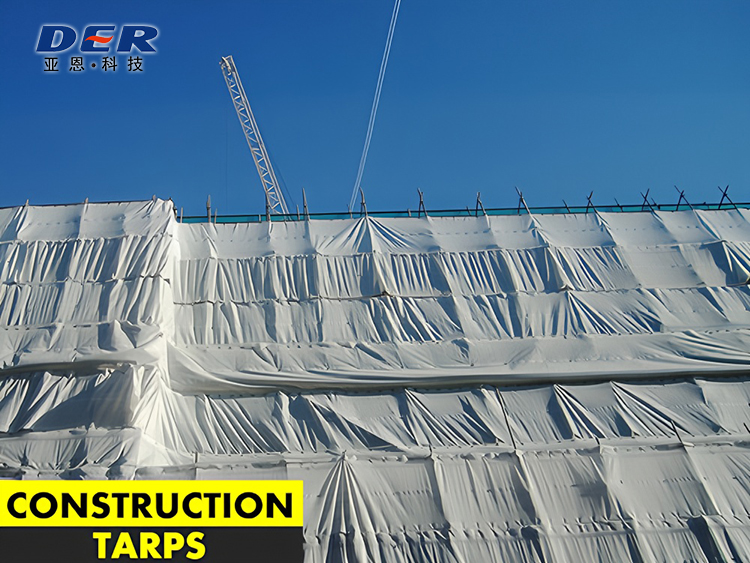
| Construction materials or site enclosures | Evaluate heavy-duty PE or a project-specific coated fabric. | Support spacing, seam layout, attachment design and any required fire test. |
| Truck and trailer covers | Select a transport-suitable reinforced grade by its technical data sheet. | Base textile, abrasion, welds, hardware and the cargo-contact geometry. |
| Large fitted machinery covers | Approve the complete fabricated prototype, not only a swatch. | Access openings, lifting/handling method, seams and reinforcement around projections. |
These are procurement starting directions derived from common product ranges; they are not engineering ratings. For construction-site tarps, the supporting and fastening system needs its own review. For truck tarps, send the cover drawing and load-contact details so the material and fabrication can be reviewed together.
PE, PVC and canvas need different specification checks
Thickness describes a physical dimension. It does not identify the reinforcement, coating chemistry or breathability of a tarp.
Read finished sheet thickness
Woven PE tarps commonly combine a woven reinforcement with a polyethylene surface layer. Check the total single-layer sheet thickness, fabric mass, weave, seams and hem construction. A thicker coating does not by itself prove a stronger woven core.
Ask whether the quoted figure is nominal or a minimum and whether it applies across the sheet, rather than at a folded edge.
Read the textile and coating together
PVC coated polyester combines a woven polyester base with a polyvinyl chloride coating. The base textile carries tensile loads; coating continuity, adhesion and the finished seams affect barrier performance and durability.
For PVC coated fabric, request thickness, GSM or oz/yd², base construction and grade-specific performance data.
Canvas is normally specified by fabric weight and treatment. A water-resistant canvas cover and a waterproof coated fabric solve different moisture-management needs. Neither a mil number nor a heavy-duty label establishes breathability.
18 oz is not 18 mil. In tarp fabric specifications, 18 oz/yd² is approximately 610 g/m². There is no universal GSM-to-mil conversion for reinforced tarpaulins. Use the separate GSM, oz and mil guide for unit definitions, and the PVC tarp vs PE tarp comparison when choosing the material family.
What should you check before choosing a thicker tarp?
Identify where the cover is likely to fail. More sheet thickness can miss the problem if damage starts at a seam, tie-down or sharp contact point.
Wear at corners and projections
Map abrasive contact points. Consider smooth supports, padding or local wear patches before increasing the weight of the entire cover. Check the representative grade’s abrasion or puncture performance where these risks dominate.
Grommet and hem pull-out
Ask how force passes from the fitting into webbing, hem and fabric. A thick sheet with an inadequately reinforced eyelet can still tear locally. Agree the attachment layout on a drawing.
Seam performance and leakage
Compare representative seams made with the intended fabrication process. Review overlap, weld quality and openings. Waterproof sheet material does not establish a leak-free finished cover.
Sunlight and low-temperature handling
Specify the exposure and handling temperatures. Request applicable weathering and flexibility evidence for the proposed grade. Thickness cannot be converted into a guaranteed number of outdoor years.
Also consider shape: a cover needs support and drainage appropriate to its installation. The heavy duty tarp product range is the commercial starting point; this guide helps define the thickness-related questions to resolve before ordering.

How do you verify actual tarp thickness?
Define what is being measured, the test method and the acceptance rule before ordering. A reading at a folded hem cannot establish the thickness of the single-layer sheet.
- Identify the specimen. State that the requirement concerns the total finished, single-layer material, including coating and reinforcement. Keep seams, hems and patches out of that particular measurement.
- Agree the method. For coated fabric, ISO 2286-3 describes thickness determination at a specified pressure. Agree the applicable method, instrument and conditioning rather than comparing readings made with different contact pressures.
- Agree a sampling plan. Take representative readings at the agreed positions across and along the material. Record individual readings so unevenness is visible; a single favorable spot is insufficient.
- Separate nominal from minimum. Put the target, allowable variation and whether acceptance uses an average, a minimum or both into the purchase specification.
- Retain traceability. Associate the results with the roll or batch, grade and approved sample. Check GSM and the required performance characteristics separately.
For broader quality requirements, use the tarpaulin specifications guide. Specify the relevant test procedure and acceptance value; naming a test standard alone is not a performance guarantee.
Will the thicker cover be manageable?
Calculate fabric mass from area and GSM. Thickness alone cannot tell you how heavy a large tarp will be.
Example: a 20 × 30 ft cover has a flat area of approximately 55.74 m². At 610 g/m², the sheet material weighs about 34.0 kg (75.0 lb), before hems, overlaps, patches, fittings or packaging. This is an arithmetic example, not a finished-product shipping weight.
If a cover is too difficult to deploy, consider panel size, access, handling arrangements and local reinforcement as part of the design. Discuss custom tarp fabrication with the intended users before approving a large production run.
Thickness and fabric-mass calculator
Convert mil to mm, or estimate sheet mass from a known area and GSM. The calculations are independent; the tool does not convert thickness into weight.
mm = mil × 0.0254. Sheet mass (kg) = area (m²) × GSM ÷ 1,000. Finished covers include additional materials.
What belongs in a heavy duty tarp specification?
Ask suppliers to quote against the same material, measurement basis and finished details. Otherwise a lower price may reflect a different product.
| Item | What the buyer should state | What to confirm |
|---|---|---|
| Material and construction | PE woven laminate, PVC coated polyester or another identified system | Exact grade and construction; avoid unspecified substitutions |
| Thickness and tolerance | Target mil/mm, minimum if needed, measuring method and acceptance basis | Finished single-layer sheet readings and agreed variation |
| Fabric weight and strength | GSM or oz/yd²; required tear, tensile or puncture criteria | Comparable test procedures and grade-specific results |
| Exposure | Sunlight, temperature, abrasion, water and any chemicals | Relevant evidence; any special formulation or testing requirements |
| Finished geometry | Finished dimensions, drops, seams, access openings and reinforcement drawing | Finished size versus cut size, seam process and attachment layout |
| Order and supply | Quantity, destination, packaging, sampling and inspection needs | MOQ, feasibility, price and lead time for the approved specification |
DER factory supplies tarp materials and reviews custom cover requirements. Request a proposed grade, technical data sheet and representative sample rather than assuming that every thickness, finish or accessory is available in every combination. Fire-retardant requirements need an identified test standard and project review; additional thickness is not evidence of fire performance.
Send the use conditions, not just “heavy duty”
Use this checklist for a thickness recommendation or a comparable bulk quotation. If the material is undecided, describe the job and ask DER factory to review the options.
Heavy duty tarp thickness FAQ
How thick should a heavy duty tarp be?
For heavy-duty polyethylene tarps, 12–20 mil (about 0.30–0.51 mm) is a common market range. For repeated outdoor covering, start by comparing 16–20 mil grades. PVC/vinyl tarps require a grade-specific thickness, weight, base fabric and reinforcement specification; the same mil number does not make different materials equivalent.
Is a 12 mil tarp considered heavy duty?
Some manufacturers sell 12 mil PE tarps as heavy duty, while others use that description for thicker grades. A 12 mil tarp can be a candidate for less abrasive covering, but the label alone does not establish tear strength, UV durability or attachment strength.
Is a 16 mil tarp better than a 12 mil tarp?
A 16 mil sheet is one-third thicker than a 12 mil sheet. That does not establish a one-third improvement in strength or life. Compare the same material family, then check actual test results, coating, seams, reinforcement and handling requirements.
Is 20 mil thick enough for a truck tarp?
Thickness alone cannot qualify a truck tarp. Twenty mil can be a useful comparison point, but transport covers also need suitable base-fabric strength, abrasion protection, seams, fastenings and a design matched to the load. Request a grade-specific technical data sheet and approve a representative finished sample.
How thick is a 20 mil tarp in millimeters?
A 20 mil tarp is exactly 0.508 mm, or 0.020 inch, by unit conversion. A commercial product marked 20 mil may have a nominal thickness and an agreed tolerance, so confirm how the finished single-layer sheet is measured.
Does 18 oz vinyl mean 18 mil?
No. In a fabric specification, 18 oz/yd² means mass per unit area and equals about 610 g/m². Mil measures thickness. There is no universal conversion from 18 oz/yd² to mil because coating density and fabric construction vary.
Will a thicker tarp last longer outdoors?
Not necessarily. Outdoor performance also depends on UV formulation, abrasion, cold flexibility, seam integrity, drainage and anchoring. Adding thickness cannot resolve a poorly reinforced grommet or an unsupported cover that repeatedly flaps against sharp edges.
Can DER factory quote a custom thickness and finished cover?
Send DER factory the application, finished drawing, material preference, target thickness and tolerance, quantity, exposure and reinforcement details. Grade availability, fabrication feasibility, samples, MOQ, testing and lead time should be confirmed against the final specification during quotation.
Technical references and basis
The thickness ranges above are comparison guidance synthesized from published supplier examples, not an industry-wide classification or a guaranteed service-life recommendation. Exact unit conversions are separate from product performance.
- Eagle Industries: Durashield woven poly tarps — published 12–20 mil product examples.
- Humphrys: tarp thickness and measurement guide — material-specific measurement and duty-range guidance.
- ISO 2286-3:2016 — thickness measurement for rubber- or plastics-coated fabrics at a specified pressure.
- ASTM D751: Standard Test Methods for Coated Fabrics — a reference family for specifying relevant coated-fabric performance tests.
Standard references describe test methods; they do not assert that every DER factory material has been tested or certified to them. Confirm documentation for the quoted grade and application.
Choose the complete cover specification
Send the application, dimensions, quantity and exposure details. DER factory can review the thickness direction alongside material selection, fabrication and reinforcement requirements before quotation.
Request A Quote